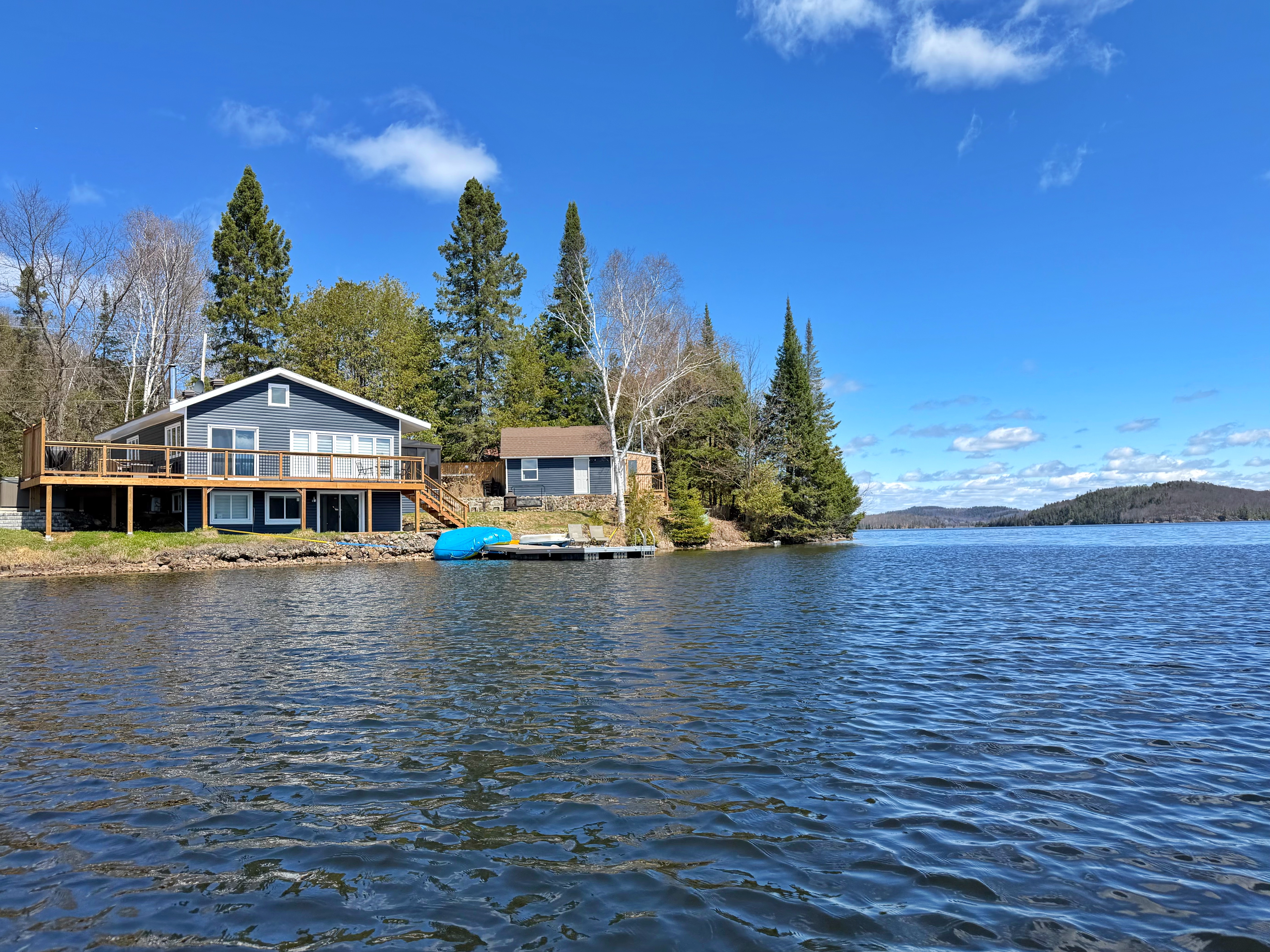
Outaouais is full of lakes, forests and rural territories that people dream about. A property on the water, a dock, an unobstructed view at sunrise: for many, this is the culmination of a life project. For others, it represents an investment opportunity in the short-term rental market, which is booming in regions like Val-des-Bois, Bowman, Duhamel or Low.
But buying a waterfront or rural property in Outaouais is not quite the same as buying a house in the city. The challenges are different, the verifications are more numerous, and mistakes can be costly. In this article, we guide you through everything you should know, ask, inspect and validate before signing anything.
1. Understanding What You Are Actually Buying
Waterfront or lake access: two very different realities
The term "lakefront" covers very different realities on Centris. Some properties are directly riparian, meaning the land physically touches the lake. Others offer shared lake access via an easement or common path. Others only have a view of the water from an elevated property.
These distinctions have a direct impact on the value of the property, on what you can build or develop there, and on your daily use. Make sure you clearly understand what the title deed describes, not just what the photos suggest.
Riparian rights in Quebec
In Quebec, the bed of lakes and rivers belongs to the State, up to the high-water mark. You own the land up to that line, but not beyond. This means that the natural beach that appears in summer during low water is not necessarily your exclusive property.
The riparian buffer zone is a protected area along the lake. Its width generally varies between 10 and 15 meters from the high-water mark. In this zone, the construction of new permanent structures, tree cutting and certain developments are prohibited or heavily regulated. Each municipality applies these rules according to its own zoning bylaw: a verification with the local urban planning department is essential before signing.
Before submitting an offer, ask your broker to verify the municipal zoning bylaw applicable to the land. What you are told verbally during a visit never replaces official documentation.
2. Autonomous Systems: Well and Septic Tank
The majority of rural and waterfront properties in Outaouais are not connected to municipal water and sewer networks. They operate with an artesian well and a septic tank. These systems are entirely reliable when properly maintained, but they require special attention when purchasing.
The artesian well
During the pre-purchase inspection, have the water quality tested: potability, flow rate and pressure. These tests are not always included in the standard inspection. Ask the following questions:
- Is the water potable according to Health Canada standards?
- What is the well flow rate in litres per minute? (a minimum of 5 L/min is generally recommended for residential use)
- Is there a history of contamination problems in this area?
- Does the water come from a surface well or an artesian well? (the artesian well is more reliable)
The septic tank
Septic installations in riparian zones are subject to even stricter requirements than elsewhere, in order to protect the water quality of lakes and rivers. A non-compliant septic tank can result in significant upgrade costs, or even municipal penalties.
Request maintenance and pumping reports from recent years. Have the system inspected by a qualified professional. An outdated or poorly positioned installation relative to the lake can represent tens of thousands of dollars in corrective work.
Sealed septic tank: a frequent reality near bodies of water
In zones immediately adjacent to a lake or watercourse, environmental regulations often prohibit the installation of a traditional leaching field. The proximity of the water and the nature of the soil do not always allow natural treatment of wastewater through the ground. In these cases, a sealed septic tank is required.
Unlike a septic tank with a leaching field, a sealed septic tank does not treat wastewater on site. It accumulates it and must be pumped regularly by a specialized company. This is an important distinction: you are not dealing with a natural treatment cycle, but with a limited-capacity reservoir that fills up according to the intensity of use of the property.
Under normal residential use, a sealed septic tank will typically need to be pumped several times a year. For an Airbnb property with sustained occupancy during the season, this pace can accelerate considerably. These pump-outs represent a recurring cost to factor into your operating budget, whether you are buying for personal use or as a rental investor.
Before purchasing, verify: what type of installation is in place (septic tank with leaching field or sealed septic tank)? If sealed, what is its capacity in litres, and how often has it been pumped in recent years? This data is normally found in the property documents or can be requested from the seller.
In 2026, a refundable tax credit covering 20% of septic upgrade costs is available, up to a maximum of $5,500, valid until March 31, 2027. This program can be combined with certain municipal Écoprêt programs.
3. Access to the Property in All Seasons
It is a detail easily forgotten during a summer visit in good weather: is the access road passable in winter? During the spring thaw?
In rural municipalities of Outaouais, several properties are accessible via private roads, forest roads or range roads that are not all plowed or maintained year-round by the municipality. Find out about:
- Who is responsible for maintaining the access road?
- Is there a road association with annual fees?
- Is the road passable after a thaw or heavy rain?
- Are there load restrictions on the road in spring?
This information may seem trivial in July, but it makes all the difference between an enjoyable property and a permanent source of stress.
4. Flood Risks and Bank Erosion
The appeal of a waterfront property comes with a risk not to be underestimated: spring flooding and natural bank erosion. Several regions of Outaouais have experienced significant flooding episodes in recent years, particularly in the Gatineau Valley and along riverbanks.
Before buying, consult the flood zone maps available from the MRC or municipality. A property in a risk zone can have direct consequences on:
- Home insurance, whose premiums can be significantly higher, or even be refused by certain insurers
- The ability to obtain mortgage financing (some lenders refuse properties in high-risk flood zones)
- Long-term resale value
What the seller's declaration will not tell you
The seller's declaration and the Centris listing document the condition of the property itself. But they do not necessarily cover what happens outside the boundaries of the land. This is a distinction that can have major consequences.
A lot may technically not be classified in a flood zone. The property itself might never be touched by water. But if the access roads to the area are subject to spring flooding, you could find yourself cut off from your own home for two or three weeks every spring. This type of situation appears nowhere in the seller's declaration, because it does not concern the property directly, but rather the neighbourhood or the range road.
In rural Outaouais, this scenario is more common than one might think. Some range roads along rivers or streams become impassable every year as soon as the snow melts. For someone who visits the property in summer, nothing hints at what spring may bring. This is why it is essential to actively seek out this information, rather than relying solely on official documents related to the property.
Since this information does not appear in official documents, here are three ways to obtain it and protect yourself:
- Ask immediate neighbours and the municipality directly.
- Your broker can make a written request to the sellers' broker, which creates a paper trail and requires a documentable response. If the selling broker or sellers declare in writing that there is no access problem related to flooding, this information becomes binding.
- It is also possible to include a condition in the purchase offer requiring written confirmation from the sellers that no road access problems related to flooding affect the area, to their knowledge. This approach formalizes the question within the transaction itself.
Bank erosion is another phenomenon to monitor. A lot can lose several centimetres per year depending on the nature of the soil, exposure to waves and water levels. A professional can assess the condition of the banks during the inspection.
5. Zoning and Acquired Rights: What Can (or Cannot) Be Built
You are buying a cottage with the intention of expanding the deck, adding a shed by the water or building a permanent dock? These projects may be prohibited or heavily regulated depending on municipal zoning and environmental regulations.
The protected riparian buffer zone generally does not allow new construction or significant interventions. Some properties benefit from acquired rights that allow existing structures to be maintained, but these rights do not automatically extend to new construction.
Items to verify with the municipality and the MRC before buying:
- Permitted uses according to zoning (residential, recreational, tourist rental, etc.)
- Applicable setback distances from the lake
- Acquired rights associated with the current property
- Permits required for planned work
Each municipality has its own bylaw. What is permitted in Lac-Simon may be prohibited in Bowman. Verification must always be done at the local municipal level, not solely at the MRC level.
6. Short-Term Rentals in Rural Outaouais: What You Need to Know Before Investing
Rural Outaouais attracts thousands of visitors every summer in search of nature, tranquility and lakes. For an investor, this represents a real opportunity, but the regulations surrounding short-term rentals (Airbnb-type) are complex and vary from one municipality to another.
The Quebec legal framework
In Quebec, any rental of 31 days or less for tourist purposes is considered tourist accommodation. Since 2021, this activity has been governed by the Act Respecting Tourist Accommodation, which requires obtaining a classification certificate from the Corporation de l'industrie touristique du Québec (CITQ).
To obtain this certificate, the property must meet municipal zoning compliance requirements. In other words: if short-term rental is not permitted in the zone where your property is located, you cannot obtain the certificate, and you cannot legally operate on Airbnb or any other platform.
Local regulations: every municipality is different
This is where things get complicated. In rural Outaouais, some municipalities actively regulate short-term rentals, others have adopted moratoriums, and others have not yet updated their regulations.
Before buying a property with the intention of renting it short-term, you must:
- Contact the municipality's urban planning department to confirm that short-term rental is permitted in the relevant zone
- Verify whether a municipal operating permit is required
- Confirm home insurance requirements for rental use
- Validate septic tank compliance, which will be more heavily used with tenants
- Inform your mortgage lender if the property is intended for rental use
Our team regularly works with buyers looking to acquire an Airbnb-oriented property in Outaouais. We can guide you toward municipalities where this type of project is feasible and help you validate the conditions before the purchase offer. Contact us at 819-328-7173.
7. Internet Connectivity: A Real Issue in 2026
In 2026, Internet connectivity is no longer a luxury, even at the cottage. If you intend to work remotely from the property, or if you want to offer a quality experience to your Airbnb guests, the availability and speed of Internet are criteria to validate before purchasing.
Outaouais has seen significant investments in digital infrastructure in recent years, but coverage remains uneven. Some areas of the Vallée-de-la-Gatineau and the MRC de Papineau have access to fiber optic or high-speed connections, while others still rely on satellite or cellular connections.
Ask the seller what Internet service is available, and verify for yourself with providers. This is an element that directly influences the rental value of a property.
8. The Pre-Purchase Inspection in Rural Settings: Going Beyond the Standard
The pre-purchase inspection is always strongly recommended. In rural and waterfront settings, it must go even further than the standard inspection of a city home. In addition to the usual elements (roof, foundations, electrical, plumbing), ask your inspector to cover:
- The condition of the well and septic tank (ideally with a specialized inspector)
- Water quality (laboratory test)
- The condition of the banks and signs of erosion
- The heating system (wood, propane, oil) and its condition
- Insulation and airtightness, particularly if the property is occupied in winter
- The condition of the dock and lakeside structures, if any
- Signs of animal presence in the structures
A thorough inspection gives you a realistic picture of the property's condition and allows you to negotiate with full knowledge of the facts, or to protect yourself through conditions in your purchase offer.
9. Financing a Recreational or Investment Property
Financing a cottage or rural property can differ from financing a primary residence. Here are the key points to know:
- For a secondary residence (personal use), the minimum down payment is generally 20%, since CMHC insurance does not apply to properties not intended as a primary residence.
- For a rental-oriented property, down payment requirements and mortgage conditions may vary depending on the declared use. Transparency with your lender is essential.
- Some properties in flood zones or with seasonal access may be refused by certain lenders or require a higher down payment.
- Four-season cottages generally hold more value in the eyes of lenders than seasonal recreational cottages.
Consult a mortgage broker early in the process to validate your financial capacity and the conditions applicable to your specific project.
Do You Have a Rural Outaouais Property Project?
Gabriel knows the territory, its particularities and its pitfalls. Whether you are looking for a cottage for your family or a rental-oriented property, he accompanies you with rigour at every step, from market analysis to signing at the notary.
Contact us: 819-328-7173
In Summary: What You Absolutely Must Verify
Buying a lakefront property in Outaouais is a magnificent project, and for many, it is one of the best decisions of their lives. But it is a purchase that requires thorough preparation and a knowledge of the territory that few generalist brokers possess.
- Verify the exact nature of the lake access right (riparian, easement, shared access)
- Confirm riparian buffer zone rules with the municipality
- Have the artesian well and septic tank inspected and tested (and identify if sealed)
- Validate access to the property in winter and during the thaw
- Consult flood zone maps
- Verify whether access roads to the area are affected by spring flooding, and obtain written confirmation if necessary
- Check zoning for any expansion or short-term rental project
- Confirm Internet availability
- Obtain a pre-purchase inspection adapted to the rural and waterfront context
- Validate financing conditions for a secondary or rental property